

If you’ve ever watched a record slowly warp because it was leaning at a weird angle, you know how much a good vinyl storage shelf matters. Records aren’t just music — they’re fragile, valuable, and weirdly temperamental about how you treat them. Getting your storage right isn’t complicated, but it does take a little know-how.
Let me walk you through what actually works.
Why Your Vinyl Storage Shelf Matters More Than You Think
Most people think any shelf will do. Just stack the records; done. But vinyl is sensitive. Heat, pressure, and bad angles can ruin a record over time.
A proper vinyl storage shelf keeps records standing upright. That’s the golden rule. Never store vinyl flat — the weight of stacked records causes warping. And once a record warps, it’s very hard to fix.
Records also need airflow. Enclosed spaces trap humidity. Humidity leads to mold, and mold ruins grooves permanently. So ventilated shelving isn’t just a nice touch—it’s actually necessary.
In my experience, the records that get damaged most often are the ones stored “temporarily” in bad conditions. There’s no such thing as temporary when it comes to vinyl.
What to Look for in a Vinyl Storage Shelf
Not all shelves are built equal. Here’s what separates a good one from a waste of money.
Weight capacity is huge. A single LP record weighs around 180 grams for heavy-press vinyl. A shelf holding 200 records is carrying around 36 kg. Flimsy particleboard won’t hold up long.
Compartment width matters too. Records are about 31.5 cm wide. Your shelf needs to be at least 33 cm deep to fit them properly without overhang.
Material is another thing to consider. Solid wood is the gold standard. It’s stable, heavy, and doesn’t flex under load. Metal shelving works well too. MDF is acceptable but can sag over time under heavy loads.
And think about adjustability. Your collection will grow. Fixed shelves limit you. Adjustable shelving lets you reconfigure as your collection expands.
Cube Shelves vs. Dedicated Vinyl Storage Shelf Units
This comes up a lot in collector communities. Should you buy a generic cube shelf or a purpose-built vinyl storage shelf?
Cube shelves — like the popular KALLAX from IKEA — are affordable and genuinely work well for records. Each cube fits roughly 60 to 80 albums. They’re modular, widely available, and easy to expand. I’ve noticed that most serious collectors start with a KALLAX and just keep adding units.
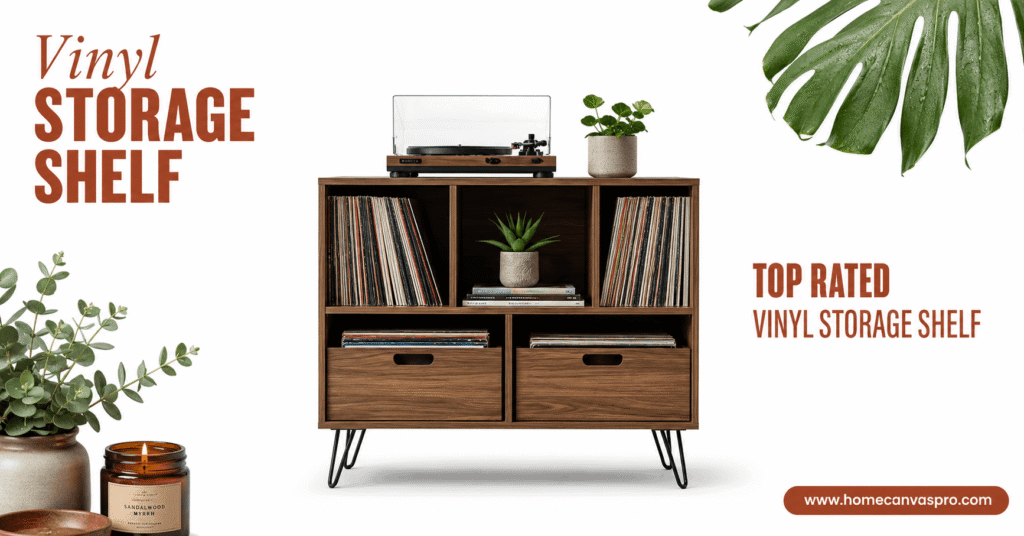
Dedicated vinyl shelves are usually built with dividers, tighter tolerances, and better wood quality. Brands like Benson Record Storage make shelves specifically engineered for LP collections. They cost more, but the build quality shows.
So which should you get? If you have under 200 records and a tight budget, go with KALLAX. If you have 500+ records and want something that looks beautiful in a listening room, invest in a dedicated unit.
How to Set Up Your Vinyl Storage Shelf Properly
Buying the right shelf is only half the job. Setup matters just as much.
Location first. Keep records away from exterior walls in cold climates. Temperature swings cause expansion and contraction. A stable interior wall is much better. Also avoid anywhere near heating vents or direct sunlight.
Level it out. An uneven shelf stresses the structure over time. Use a spirit level and adjust the feet. Most shelves come with adjustable feet for exactly this reason.
Don’t overfill sections. It’s tempting to pack records in tight. But records need slight breathing room. If you’re jamming them in, you risk sleeve damage and make browsing a chore. Fill each section to about 80% capacity.
Use dividers. Alphabetical or genre dividers keep things browsable. Vinyl Styl makes affordable record dividers that fit most shelf depths. Small thing, big quality-of-life upgrade.
Protecting Your Records Alongside Good Shelving
A vinyl storage shelf does a lot of work. But it can’t do everything alone.
Inner and outer sleeves make a real difference. Plain paper inner sleeves scratch records over time. Switch to Mobile Fidelity polyethylene sleeves — they’re anti-static and much gentler on grooves.
Outer plastic sleeves protect the album art. A warped or torn cover drops resale value fast. Slip every record into a polypropylene outer sleeve before shelving it.
Temperature and humidity are ongoing concerns. Aim for 65–70°F and 45–50% relative humidity. A simple hygrometer near your shelf helps you monitor conditions. If you’re in a humid climate, a small dehumidifier nearby goes a long way.
How Many Records Can a Vinyl Storage Shelf Hold?
This depends on the shelf design, but here’s a rough guide.
A standard KALLAX cube holds 60 to 80 albums per cube. A 4×4 KALLAX unit — 16 cubes — can hold 960 to 1,280 records. That’s a serious collection in a reasonably small footprint.
Dedicated shelving units vary more. Some are designed for 200 records, others for 1,000+. Always check the manufacturer’s stated capacity and then assume you’ll fill it faster than expected. Collections have a way of growing.
And if you’re buying used shelving, check for sagging. Run your hand along each shelf level. Any noticeable bow means the shelf has already been stressed. Walk away.
Common Mistakes to Avoid
Storing records horizontally. Already mentioned this, but it’s worth repeating. Flat storage leads to warping. Always vertical.
Ignoring weight limits. Overloaded shelves fail suddenly. Know the limit and respect it.
Putting shelves near windows. UV light fades album art and can affect the vinyl itself over time. Keep shelves out of direct sunlight.
Mixing different media on the same shelf. Books are heavy and irregular in size. They can shift and put pressure on records. Keep your vinyl on its own dedicated vinyl storage shelf.
Neglecting cleaning before shelving. Shelving a dirty record seals grime into the sleeve. Give each record a quick clean before it goes onto the shelf. It saves time and your stylus.
A Quick Word on DIY Options
Some collectors build their own shelving. It’s not as complicated as it sounds. Basic woodworking skills and the right lumber get you a custom unit for less than most retail options.
The key is using hardwood—oak, maple, or pine, at minimum. Build compartments at 33 cm wide and 33 cm deep. Add a backing panel to keep records upright. And sand everything smooth—rough wood catches on sleeves.
DIY also lets you build to an exact space. Awkward rooms or tight nooks become less of a problem when you can customize dimensions.
The Bottom Line on Choosing a Vinyl Storage Shelf
Your records deserve proper care. A good vinyl storage shelf isn’t just furniture—it’s the thing that keeps your collection sounding great for decades.
Start with your current collection size. Pick a shelf that fits your space and your budget. Prioritize weight capacity, material quality, and vertical storage. And then set it up right — good location, proper loading, a few dividers.
Do all that, and your records will thank you every time the needle drops.
Also Read: Howard Restor A Finish: Revive Wood Without Stripping